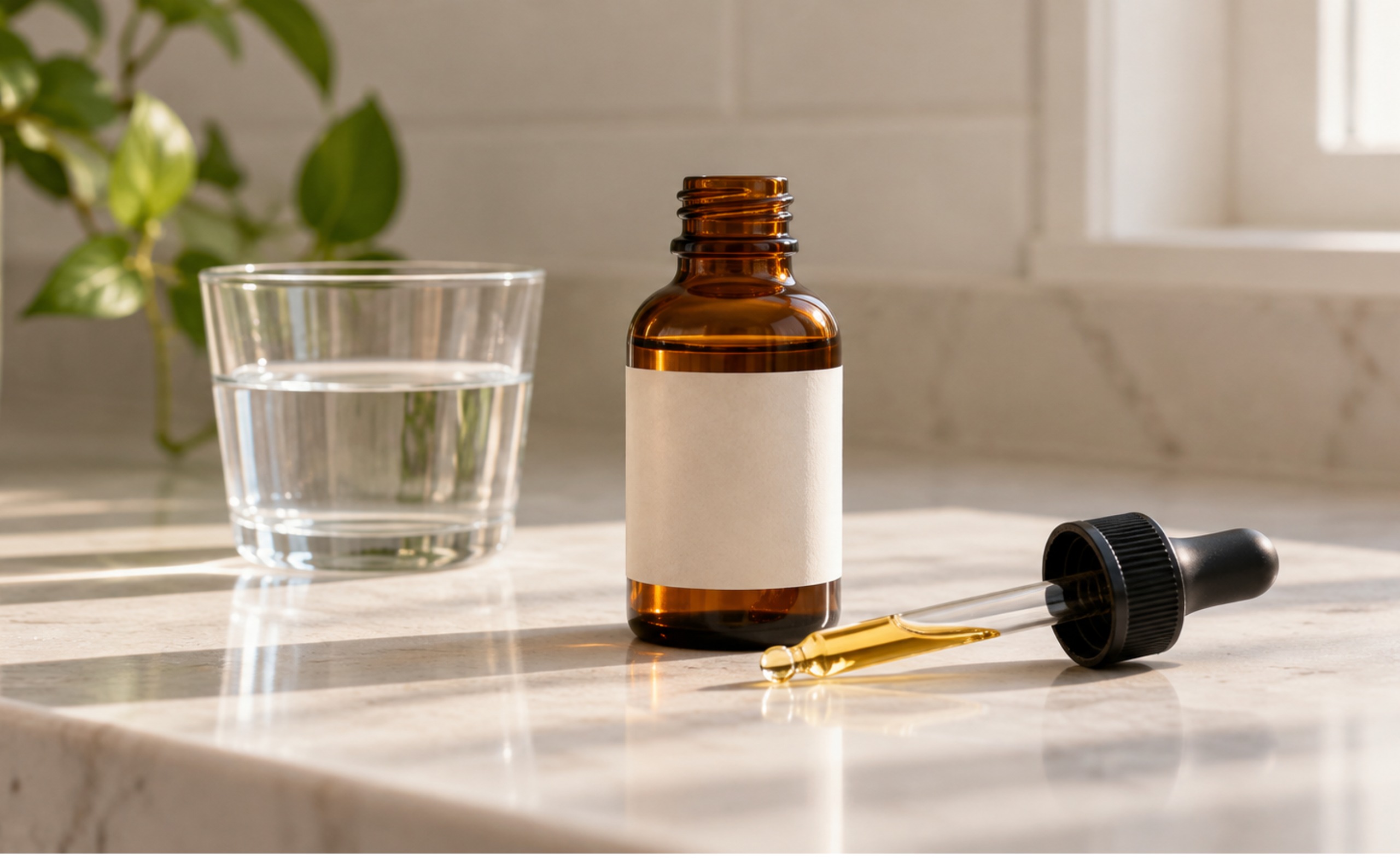
A cannabis tincture is a liquid cannabis extract, usually in alcohol or oil, that you measure with a dropper. To use one, you place the dose under your tongue, hold it there as the label directs, and wait for the effects before taking more. Under the tongue, a tincture generally takes effect faster than an edible, often within roughly 15 to 60 minutes, and its effects typically last several hours. The right amount depends on the product’s strength and on you, so the safest approach is to start with a small dose and wait.
This guide explains what tinctures are, how to take one sublingually step by step, what onset and duration to expect, how to think about dosing without repeating a general dosing guide, and how to read a tincture label. It is general education for adults 21 and older, not medical advice. If you take medications or have a health condition, talk with a healthcare provider before using cannabis.
What Is a Cannabis Tincture?
A tincture is a concentrated liquid made by extracting cannabinoids from cannabis into a carrier. The carrier is commonly alcohol or an oil such as a plant-based oil, and the finished product is sold in a small bottle with a dropper. Because the cannabinoid content is listed per milliliter, tinctures let you measure a dose by volume instead of estimating by eye, which is one reason many people who want predictable amounts prefer them to smoking or eating cannabis.
Tinctures come in several cannabinoid profiles. Some are THC-dominant, which means they are intended to produce a noticeable intoxicating effect. Some are CBD-dominant and are marketed for people who want less intoxication. Others combine THC and CBD in a stated ratio. The label tells you which type you are buying, and the difference matters because it changes what you should expect and how much you should take.
How Tinctures Work
Tinctures are most often taken sublingually, which means under the tongue. The tissue under the tongue is thin and rich in blood vessels, so some of the cannabinoids can be absorbed through the lining of the mouth and enter the bloodstream without first passing through the digestive system and the liver. A clinical review of cannabis pharmacology describes sublingual formulations as having a faster onset than oral formulations, roughly 15 to 60 minutes, with peak effects around 45 minutes and a duration of about 4 to 6 hours.
The same review describes oral formulations, such as edibles, as having a delayed onset of about 1 to 3 hours and a longer duration of roughly 6 to 12 hours, partly because THC is extensively metabolized in the liver. If you swallow a tincture instead of holding it in your mouth, it behaves more like an edible. Reviews also note that absorption through the mouth can be limited and variable, which is another reason to treat the numbers above as typical ranges rather than guarantees.
How to Use a Cannabis Tincture Step by Step
- Read the label first. Check the cannabinoid content per milliliter, the serving size, and the directions. Products differ.
- Shake or mix if the label says to. Some tinctures separate and need mixing before each use.
- Measure carefully. Use the dropper’s markings or the included measuring tool. Do not estimate.
- Place the dose under your tongue. Release the liquid under the tongue rather than onto the surface of the tongue.
- Hold it as directed. Follow the product’s directions for how long to keep the liquid under the tongue before swallowing, because hold times differ between products and the label is the authority for your bottle.
- Wait before taking more. Give the dose time to take full effect before considering another one, which is longer than you may expect.
- Record what you took. Note the product, the amount, the time, and how you felt, so you can adjust with information next time.
Avoid rinsing your mouth, eating, or drinking right away if the label advises against it, since the label is the best guide to what works for that product.
Onset Time and Duration
For a sublingual tincture, plan for onset in roughly 15 to 60 minutes, a peak somewhere around 45 minutes to an hour or more, and effects that may last about 4 to 6 hours, with some people noticing effects for longer. These ranges come from clinical literature on sublingual THC and are not guarantees. Your own experience can differ based on your body weight, metabolism, tolerance, whether you have eaten, whether you swallow the liquid or keep it in your mouth, and the specific product formulation.
| Method | Typical onset | Typical duration |
|---|---|---|
| Inhaled (smoked or vaporized) | Within minutes | Shorter than oral routes |
| Sublingual tincture | About 15 to 60 minutes | About 4 to 6 hours |
| Edible or swallowed | About 1 to 3 hours | About 6 to 12 hours |
If you want to compare tinctures with other products, our guide to fast acting edibles explains how edible onset works.
Dosing Considerations for Tinctures
Tinctures are measured by volume, but cannabinoids are measured in milligrams, so the label does the math between the two. If a bottle contains 10 milligrams of THC per milliliter and your dropper holds 1 milliliter when full, then half a dropper contains about 5 milligrams and a quarter of a dropper about 2.5 milligrams. Always use the numbers on your own product, because concentrations vary widely from one tincture to another.
General dosing guidance for beginners applies to tinctures as well: start low, go slowly, and wait before taking more. Our beginner’s guide to choosing the right THC dose covers the factors that influence how much you need, and our guide to the safest way to try cannabis for the first time explains how to set up a first experience. This article focuses on what is specific to tinctures: the sublingual route, dropper measurement, and label reading.
One tincture-specific tip is consistency. Because dropper volumes and bottle concentrations differ, changing products can change your dose even if you use the same number of drops. If you switch brands, treat the new product like a new product and start again from a small amount.
How to Read a Tincture Label
A tincture label contains the information you need to measure and use the product safely. Take a minute to find each of these before you buy.
- Cannabinoid content per serving and per container: Look for milligrams of THC and CBD per milliliter, per serving, and for the whole bottle.
- Serving size and dropper volume: Check how much liquid counts as one serving and how the dropper is marked.
- Cannabinoid ratio: If the product lists a THC to CBD ratio, it describes how the two cannabinoids compare.
- Carrier and other ingredients: Check the carrier oil or alcohol and any flavorings or additives, especially if you have allergies or sensitivities.
- Directions and warnings: Follow the product’s directions, including how to use the dropper and how long to keep the liquid in your mouth.
- Testing and batch information: Licensed products are tested. Our guide to what lab-tested cannabis means explains how to read the results.
- Required symbols: In Colorado, the Marijuana Enforcement Division requires retail cannabis products to carry the universal THC symbol and be sold in child-resistant packaging.
What to Expect After Taking a Tincture
Effects depend on the cannabinoid profile and the dose. With a THC-dominant tincture, commonly reported effects include a sense of relaxation or euphoria, altered perception of time, and changes in mood. Commonly reported side effects can include dry mouth, dizziness, increased heart rate, anxiety, and impaired coordination and judgment, and these become more likely with higher doses. Effects can feel different if you take the dose on an empty stomach or after a meal, and tolerance, body size, and individual sensitivity all play a role.
If you feel more intoxicated than you wanted, stay calm, sit or lie down somewhere comfortable, drink water, and remember that the effects will fade. If you feel unwell, have severe symptoms, or are worried, seek medical help. Avoid taking a second dose to feel better.
Troubleshooting Common Tincture Questions
“I did not feel anything.” Give it more time before deciding the dose was too low. A sublingual tincture can take 15 to 60 minutes, and a swallowed one can take much longer. If you swallowed the liquid right away instead of holding it under your tongue, the slower, edible-like onset is probably why. Resist the urge to repeat the dose immediately, and use the notes you recorded to adjust next time.
“It was stronger than I expected.” Treat that as useful information. Next time, reduce the amount, and check that you read the concentration per milliliter correctly, since a stronger bottle or a larger measure can change the dose even if the number of drops seems familiar.
“The taste is unpleasant.” The carrier and any flavoring affect taste, and different products can taste very different. Check the ingredients, ask a budtender about options, and keep in mind that any change to the product means measuring carefully again.
Safety and Storage
Never drive or operate machinery after using cannabis. Colorado’s health agency notes that someone whose ability to drive is affected to the slightest degree can be charged with impaired driving even though adult use is legal. The state also warns that cannabis use during pregnancy is unsafe.
Keep tinctures in their original child-resistant packaging, stored out of sight and out of reach of children and pets. Colorado’s health agency says that keeping cannabis in the packaging from the store is the first step in safe storage. The liquid format makes tinctures appealing to children, who can mistake them for ordinary drops or flavored liquids.
Tinctures Compared With Other Formats
Many people choose tinctures because they offer measurable doses without smoke and a faster onset than edibles. The tradeoff is that a sublingual tincture generally takes longer to work than inhaling cannabis and is less immediate than a vape or a joint, and the taste of the carrier can be strong. Tinctures can be less convenient to carry discreetly than a single gummy, though many people appreciate that they do not involve inhaling anything.
Which format fits you depends on how quickly you want effects, how precisely you want to measure, and what you enjoy. If you are unsure, ask your budtender to explain the strength of each tincture on the shelf and how it compares with other products.
Where to Find Tinctures
Rocky Mountain Cannabis stores carry tinctures alongside other product categories. Availability and strengths vary by store, so check your local store’s online menu or ask a budtender. You can find every location on our store locator.
Frequently Asked Questions
How long does a cannabis tincture take to work?
Under the tongue, tinctures typically take effect in roughly 15 to 60 minutes, according to clinical literature, with peak effects around 45 minutes. Swallowed tinctures act more like edibles and can take 1 to 3 hours.
How long do tincture effects last?
Sublingual effects typically last about 4 to 6 hours, though duration varies with the dose, the product, and the person.
How long should I hold a tincture under my tongue?
Follow your product’s label. Directions differ between products, and absorption through the mouth can be limited and variable, so the label for your specific tincture is the best guide.
What happens if I swallow a tincture instead of holding it under my tongue?
It is absorbed through the digestive system and processed by the liver, so it behaves more like an edible, with a slower onset and a longer duration.
How do I calculate how much THC is in one dropper?
Multiply the milligrams of THC per milliliter on the label by the volume of liquid you use. For example, a 10 milligram per milliliter tincture contains about 5 milligrams in half a milliliter.
Can I add a tincture to food or a drink?
You can, but it will then act like an edible, with a slower onset and longer duration, and it can be harder to judge the dose. Follow the label and wait before taking more.
Sources & References
- The Permanente Journal, sublingual cannabis pharmacokinetics review: https://www.thepermanentejournal.org/doi/10.7812/TPP/24.088
- NIDA, Cannabis (Marijuana): https://nida.nih.gov/research-topics/cannabis-marijuana
- CDPHE, Health Effects of Marijuana Use: https://cannabis.colorado.gov/health-effects-of-marijuana-use
- CDPHE, Driving and Traveling: https://cannabis.colorado.gov/legal-marijuana-use/driving-and-traveling
- 1 CCR 212-3 (MED Rules), packaging and labeling: https://www.law.cornell.edu/regulations/colorado/1-CCR-212-3-6-905
- Colorado testing requirements (MED rules): https://www.law.cornell.edu/regulations/colorado/1-CCR-212-3-4-215